
Last updated: October 11, 2026. General information, not engineering or legal advice. Prices are published national figures and will differ in your area.
“French drain” covers three different jobs: a shallow trench in the yard, a drain along the outside footing, and a drain cut into the basement floor. They do not cost the same, and many online prices blur them together. This guide separates them so you can read a quote correctly.
The short answer
LawnStarter (updated October 2026) puts the average professionally installed French drain at about $5,000, with most projects between $1,650 and $12,250 and extremes from about $500 to $18,000. Exterior drains are cheaper per foot than interior ones, because an interior drain means cutting and repairing a concrete floor.
Cost per linear foot
| Source | Exterior / yard drain | Interior perimeter drain |
|---|---|---|
| LawnStarter (Oct 2026) | $10–$65 per linear foot | $40–$100 per linear foot |
| Fixr (Feb 2026) | $10–$100 per linear foot | $40–$120 per linear foot |
| This Old House (Mar 2026) | $10–$100 per linear foot (French drains) | $60–$120 per linear foot for a weeping tile system; a different section lists $25–$55 for subfloor drain tile |
Note that This Old House gives two different interior figures in the same article. That kind of internal inconsistency is common in cost guides, which is why you should always price your own job by length and scope.
Typical totals by length
| Length | Exterior (LawnStarter) | Interior (LawnStarter) |
|---|---|---|
| 50 feet | $500–$3,250 | $2,000–$5,000 |
| 100 feet | $1,000–$6,500 | $4,000–$10,000 |
| 200 feet | $2,000–$13,000 | $8,000–$20,000 |
For a basement about 30 by 33 feet, the perimeter is roughly 126 feet. At LawnStarter’s interior range of $40 to $100 per foot, a full perimeter drain would run about $5,040 to $12,600, before the sump pump. That is our arithmetic, not a quote. It shows why a full interior system is often a four- or five-figure job.
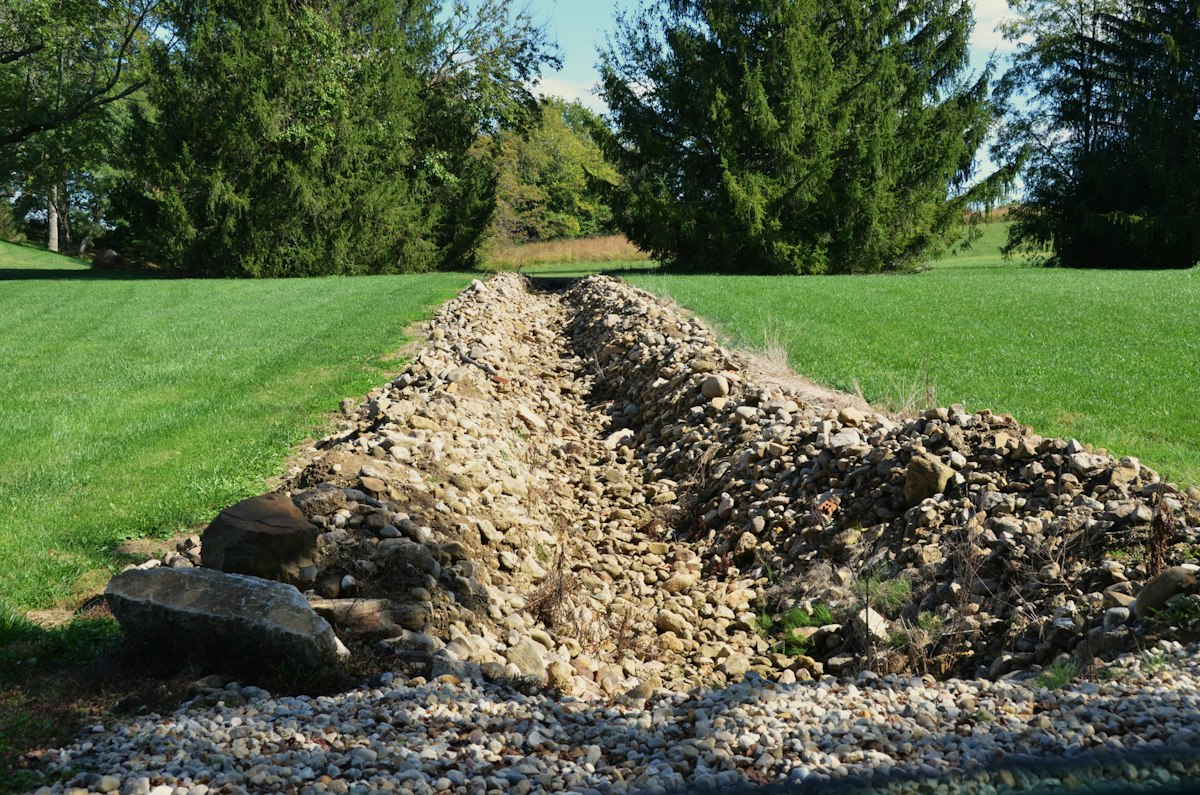
Three kinds of “French drain”
- Yard (surface) drain. A trench with gravel and perforated pipe that carries runoff away from the house. Shallower and cheaper.
- Exterior footing drain. A drain at the base of the foundation. LawnStarter says footing drains sit at least a foot deep and cost more than shallow ones. Installing one on an existing home usually means excavating, which is the main cost. See interior vs. exterior waterproofing.
- Interior perimeter drain. Cut into the basement floor along the walls and routed to a sump pit. Madison describes it as a perforated pipe placed inside the footing perimeter that requires cutting out the slab edge.
What drives the price
- Soil. Shale and clay are harder to dig, especially for deep footing drains.
- Access. If equipment cannot reach the area, hand digging adds time.
- Materials. LawnStarter lists pipe at about $0.50 to $3 per foot and pea gravel at about $25 to $53 per ton. Labor and equipment make up most of the cost.
- A sump pump. Needed when gravity cannot carry the water away. See our sump pump buyer’s guide.
- Add-ons. Dry wells, storm drain connections, rain gardens or decorative covers raise the total.
- Permits. LawnStarter lists about $58 to $225; Fixr lists $75 to $500.
- Landscaping and surface repair. Rarely included unless the quote says so.
Will a French drain fix your basement?
It depends on where the water comes from. If rain runs toward the house because of poor grading or short downspouts, Madison’s guidance says to fix those first, since they may solve the problem alone. A drain only works if water can reach it and there is somewhere for it to go: the pipe must drain by gravity to daylight, or to a sump pit with a working pump. Our comparison of French drain vs. sump pump explains how the two work together, and the full cost guide places this price in context.
Cheaper things to try before you dig
A drain is a response to water that is already collecting near the foundation. Cutting off that water at the source is usually cheaper. Fixr lists gutters and downspouts at about $3 to $30 per linear foot, and extending downspouts or re-sloping soil away from the house can cost less still. Madison’s guidance recommends this order: grading and gutters first, then exterior drainage, then interior drainage. Our exterior drainage guide covers these surface fixes.
Two example budgets, worked out
These examples use the published ranges above. They are illustrations, not quotes.
- A 100-foot yard drain to move runoff away from a low spot. LawnStarter’s exterior range for 100 feet is $1,000 to $6,500. The wide spread reflects depth, soil and access.
- A full interior perimeter drain in a 126-foot basement. At $40 to $100 per foot, that is about $5,040 to $12,600, plus a sump pump if there is no pit yet. LawnStarter’s own table for 100 feet interior ($4,000 to $10,000) and 200 feet ($8,000 to $20,000) brackets the same result.
Even with generous assumptions, a basement drain system costs several times what a yard drain does. If one quote is far below the other, find out whether it covers the same footage, the same depth and a pump.
Mistakes to avoid when comparing quotes
- Comparing a per-foot yard drain price to a total price for an interior system.
- Assuming a drain includes restoration of concrete, landscaping or sod. Ask.
- Ignoring where the water will discharge. A drain with nowhere to send water will back up.
- Skipping the permit. Rules vary by city, and Madison, for one, requires permits for sump pumps.
- Choosing on price alone. A cheap quote that leaves out the pump or the discharge line can cost more in the end.
Getting an honest quote
- Ask which type of drain is being priced and its length in linear feet.
- Ask what depth, pipe, gravel and filter fabric are included.
- Ask where the water will go, and whether a pump or permit is needed.
- Ask whether surface restoration (sod, concrete, landscaping) is included.
- Compare at least three itemized quotes; our guide on hiring a contractor covers licenses, contracts and deposits.
Related guides
How we put this guide together
This guide was drafted with AI assistance and then edited for the site against the public sources listed below. We are not contractors or engineers, and the prices are not quotes. Per-foot and total figures come from the cited cost pages as of their stated dates; the perimeter calculation is ours. If you spot an error, use the contact page and we will correct it.
Leave a Reply