Last updated: October 11, 2026. General information, not engineering advice. Local codes and soil conditions vary.
These two get compared constantly, but they do different jobs. A French drain collects and carries water. A sump pump lifts water that cannot flow away on its own. In many basements you need both, working as one system. This guide explains how each works, what each costs and how to tell which problem you actually have.
The short answer
A drain moves water to a destination; a pump moves it up and out. LawnStarter notes a sump pump is needed when gravity alone cannot drain the water. Interior drains in a basement usually lead to a sump pit, which is why they are often sold together. Exterior drains can discharge by gravity to daylight if the yard slopes away. Neither works well if the surface water around the house is not managed first.
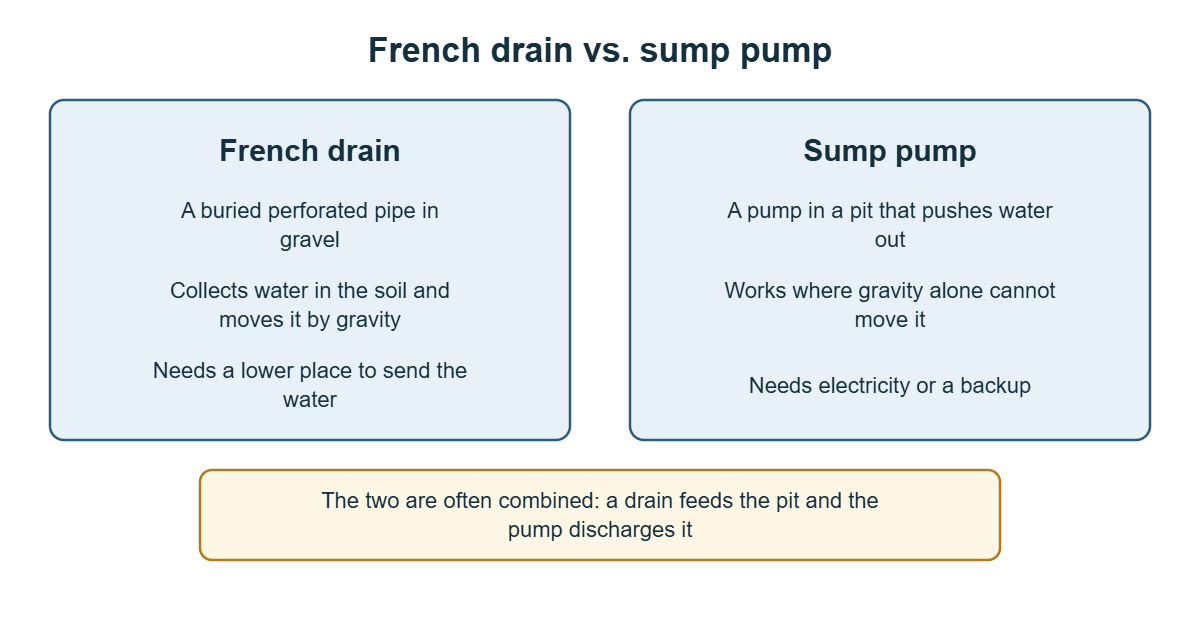
Side by side
| French drain | Sump pump | |
|---|---|---|
| What it is | A gravel-filled trench with perforated pipe | A pump in a pit that discharges water outside |
| What it does | Collects water and carries it away | Lifts collected water out of the pit |
| Needs power? | No, if it drains by gravity | Yes; backup advised |
| Moving parts | None | Pump, float, check valve |
| Typical cost | Exterior $10 to $65 per foot; interior $40 to $100 per foot (LawnStarter) | $1,200 to $2,500 installed (Bob Vila, This Old House) |
| Maintenance | Occasional inspection of outlets | Regular testing; see our maintenance checklist |
| Fails when | Pipe clogs with silt or has nowhere to drain | Power fails, float sticks, pump wears out |
When a French drain alone may be enough
- Water pools in the yard or against the house because of surface or shallow groundwater.
- The yard slopes enough that the pipe can discharge by gravity to daylight.
- You want a system with no moving parts that does not depend on power.
When you need a sump pump
- A basement interior drain collects water that has nowhere to flow by gravity.
- Groundwater rises toward the floor level.
- An exterior footing drain cannot reach daylight and must drain to a pit (Madison says the drains must lead to a sump).
- You need to lift water out of the basement and away from the house.
Why they are often used together
Madison describes the interior system as a perforated pipe inside the footing perimeter that drains to a sump, and says exterior drain tile along the footing must also lead to a sump. This Old House notes pumps can fail during storms, so backup pumps and battery systems are worth considering. In practice, the drain provides the path and the pump provides the exit.
Costs in context
- LawnStarter: the average professionally installed French drain is about $5,000, with most projects from $1,650 to $12,250.
- Fixr: interior perimeter drain at $40 to $120 per linear foot; sump pump $600 to $2,500.
- Bob Vila: sump pump installation about $1,200 to $2,500, average near $1,500; concrete floor work $2,500 to $5,000.
Our guides on French drain cost and sump pump installation cost break these numbers down.
How to decide
- Check grading, gutters and downspouts first (Madison). Our exterior drainage guide covers the surface fixes.
- Work out where the water enters: through the wall, up through the floor or along the joint. See warning signs.
- Ask whether the water can drain by gravity to daylight. If yes, a drain may be enough. If not, you need a pit and pump.
- Get itemized quotes for the drain, the pit and the pump, and ask about backup power.
- Compare against exterior options in interior vs. exterior waterproofing.
Mistakes to avoid
- Buying a pump when the real problem is a downspout dumping at the wall.
- Installing a drain with nowhere for the water to go.
- Skipping the check valve, backup or cover. Madison says a sump needs an airtight cover.
- Never testing the pump. See the sump pump maintenance checklist.
Three scenarios
- Damp yard, dry basement. Water pools outside after rain but the basement stays dry. A yard drain or regrading may be all that is needed, and a pump is probably not.
- Water along the basement wall base during storms. An interior perimeter drain leading to a sump pit with a pump and battery backup is the usual pairing. See interior vs. exterior waterproofing for the alternative.
- A pump already in place that runs constantly. Investigate where all that water comes from. Better gutters, grading or an added drain may reduce the load and extend the life of the pump.
Can a French drain replace a sump pump?
Only if the drain can discharge by gravity to a lower point and the water level will not rise above it. In a typical basement with the floor below the surrounding grade, interior drain tile has to lead to a pit, which means a pump. If you have a high water table or low-permeability soil, ask the contractor how the system handles rising groundwater. Madison notes that in low-permeability soil an interior system may not handle rising groundwater without a gravel layer under the slab.
Questions to ask before you buy either
- Where will the water discharge, and does it need to be pumped?
- What happens during a power outage?
- What maintenance does the system need, and who does it?
- Is a permit needed? Madison, for example, requires one for sump pumps.
- What does the warranty cover?
Related guides
- How to choose a basement sump pump
- Exterior drainage systems for basements
- Curtain drain vs. French drain
How we put this guide together
This guide was drafted with AI assistance and then edited for the site against the public sources listed below. We are not engineers or contractors. Cost figures come from LawnStarter, Fixr, Bob Vila and This Old House; the functional descriptions are drawn from Madison and LawnStarter. If you spot an error, use the contact page and we will correct it.
Leave a Reply