
Last updated: October 11, 2026. This guide is general information, not engineering or legal advice. Prices are published national figures and will differ in your area.
When water gets into a basement, contractors tend to push the system they sell. An interior drainage company will say outside excavation is overpriced. An excavation company will call interior drains a bandage. Both have a point, and neither tells you whether your house needs the work at all. This guide explains what each approach does, what published sources say it costs, and how to decide where to start.
The short answer
Interior drainage collects water that has already reached the wall or floor and sends it to a sump pit. Exterior waterproofing keeps water away from the wall by digging down to the footing and sealing and draining the outside. Exterior work usually costs more and is more disruptive. Neither is automatically the better choice. Which one fits depends on where the water comes from, and the cheapest fixes (grading and gutters) should come before either.
How interior drainage works
An interior system lives inside the basement. The slab is cut along the perimeter, a perforated pipe is laid in gravel, and the pipe drains to a sump pit where a pump sends water outside. The City of Madison describes it as a perforated pipe placed inside the footing perimeter that requires cutting out the edge of the slab and drains to a sump. For block walls, dimpled plastic sheeting at the base of the wall can help guide water to the pipe.
- What it solves: water on the floor and at the base of walls, including water pushed up by groundwater.
- What it does not do: it does not stop water from reaching the outside of the wall. Walls can still stay damp or show staining.
- What it depends on: a working pump. A power outage during a storm is the classic failure, so a battery backup matters. See our cost guide for how sump pump prices compare.
- A limit to know about: the Madison guidance notes that in low-permeability soil an interior system may not handle rising groundwater without a gravel layer under the slab.
How exterior waterproofing works
Exterior work means excavating around the foundation, down to the footing, then cleaning the wall, applying a waterproofing membrane, adding drainage board, and installing drain tile along the footing that leads to a sump or daylight. Backfill goes in last. Madison calls it the most expensive option and also the most effective. This Old House notes the excavation phase alone can take one to two weeks.
- What it solves: water working through the wall from the soil side, and failed or missing exterior drainage.
- What it costs you besides money: landscaping, patios, steps or decks next to the house may have to be removed and rebuilt.
- What it may not solve: water coming up through the floor from a high water table, because that water never touches the outside of the wall.
What the published sources say it costs
Published prices for this work disagree, partly because they average different jobs. These are the ranges from the sources we reviewed.
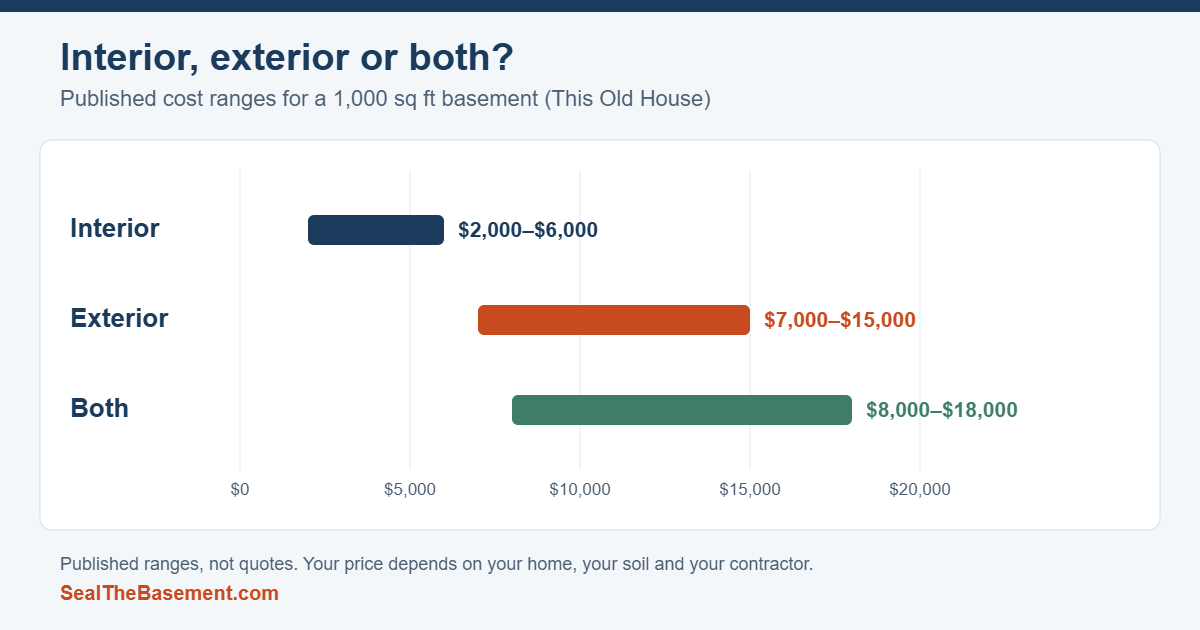
| Source | Interior | Exterior | Notes |
|---|---|---|---|
| This Old House (updated March 2026) | About $3,000 average; $2,000–$6,000 in its summary table | About $7,000 average; $7,000–$15,000 in its table | Based on a 1,000 sq ft basement. Interior plus exterior together: $8,000–$18,000. Sump pump installed: $1,200–$2,500. |
| Fixr (updated February 2026) | Interior perimeter drain: $40–$120 per linear foot | French drain: $10–$100 per linear foot | Total basement waterproofing about $5,000 ($3,000–$10,000). Sump pump $600–$2,500. Permits $75–$500 extra. |
| Bob Vila (last updated June 2024) | $200–$3,000 (sealing) | $1,000–$15,000 (sealing) | National average given as $4,920. Says exterior work may be the only option with a high water table. |
Notice that these figures are far below some numbers you may see in contractor marketing. They are national averages for typical jobs. A deep foundation, a house with a deck or driveway against the wall, or a tight lot can push a real quote above them, so treat the table as a sanity check rather than a ceiling.
Why quotes for the same house can differ so much
Per-foot pricing explains a lot of the spread. A basement about 30 by 33 feet has roughly 126 feet of perimeter. At the $40–$120 per linear foot range Fixr lists for an interior perimeter drain, that is about $5,000 to $15,000 for the drain alone, which is well above This Old House’s $2,000–$6,000 summary range. Neither source is necessarily wrong. They are describing different scopes.
That is why you should ask every contractor for an itemized quote that shows linear feet of drain, sump pump model, battery backup, discharge line, and permit fees. If you need help comparing, our guide on how to hire a basement waterproofing contractor explains how to line quotes up.
Start with the cheap fixes first
Madison’s flooding guidance puts it plainly: many water problems can be solved above ground, and grading and gutters should come before any below-ground drainage because they may fix the problem alone. That means downspout extensions that carry water away from the house and soil sloped away from the foundation. Even if you end up needing a drain system, moving water away at the surface reduces the load on it. Our exterior drainage guide covers these surface fixes.
When interior drainage is the sensible choice
- Water appears at the base of walls or on the floor after heavy rain, and the surface drainage is already good.
- You cannot or do not want to dig up the yard, or there are structures, utilities or tight property lines outside.
- The cost of exterior excavation would be out of proportion to the problem.
- You want a system that can be installed in a few days, regardless of season.
When exterior waterproofing deserves a serious look
- The wall itself is leaking from the soil side and the exterior drainage has clearly failed.
- You are building new or already have the foundation exposed. Doing it before backfill is far cheaper than digging later.
- A contractor or engineer finds damage that needs repair from the outside, such as deteriorating wall surfaces.
- Interior work has been done and the wall problem persists.
If you see bowing walls or large, growing cracks, hire a licensed structural engineer before choosing a waterproofing system. Waterproofing does not fix a structural problem.
A quick way to match the problem to a starting point
| What you see | Likely starting point |
|---|---|
| Damp spots after rain, downspouts dump near the house | Fix gutters, downspouts and grading first |
| Water on the floor at the wall base | Interior drain and sump, after checking grading |
| Water coming through the wall itself | Exterior drainage or membrane, or a professional assessment |
| Water rising from the floor with heavy rain | Interior drain and sump; exterior work alone will not stop it |
| Bowing walls, wide or growing cracks | Structural engineer before any waterproofing decision |
This table is a starting point for questions, not a diagnosis. Our guides on warning signs of basement water problems and water seeping through walls after rain can help you describe what you are seeing to a contractor.
Paint, sealers and dampproofing are not waterproofing
Some quotes include waterproof paint or sealer, which Fixr prices at roughly $1 to $8 per square foot. These can help with humidity, but they are not designed to hold back water under pressure. The Building America foundation handbook from Oak Ridge National Laboratory makes the same distinction: dampproofing reduces moisture but will not stop water under hydrostatic pressure, while waterproofing is recommended where rain, irrigation or snowmelt can create that pressure. If a contractor offers a coating alone for an active leak, ask what happens when the water pressure builds.
Questions to ask before you choose
- What is causing the water here, and how did you determine that?
- Have grading and gutters been checked and fixed first?
- Is the quote itemized by linear foot, pump, backup power and discharge?
- What does the warranty cover, and is it transferable?
- Is a permit required, and who pulls it? Madison, for one, requires a building permit for sump pumps.
- Is it written into the contract, and does it list the work and the warranty?
Related guides
How we put this guide together
This guide was drafted with AI assistance and then reviewed and edited by Leonel Vanegas, the site editor, against the public sources listed below. We are not contractors or engineers. Prices come from the cited pages as of their stated update dates and are not quotes. If you find an error, use the contact page and we will correct it.
Sources
- This Old House: Basement Waterproofing Cost (updated March 2026)
- Fixr: How Much Does It Cost to Waterproof a Basement? (updated February 2026)
- Bob Vila: Basement Waterproofing Costs (updated June 2024)
- City of Madison: Prevent Basement Flooding
- Oak Ridge National Laboratory, Foundation Handbook: Drainage
Leave a Reply