
Last updated: October 11, 2026. General information, not engineering advice.
Water seeping through a basement wall after rain is one of the most common complaints, and one of the easiest to misdiagnose. The wet spot is where water appears, not necessarily where it enters. This guide shows how to work out the real path and which fix matches which cause.
The short answer
Water reaches basement walls after rain because the soil outside gets saturated and presses water through cracks, joints and pores, or because surface water pools at the foundation. The Oak Ridge National Laboratory foundation handbook notes that dampproofing does not stop water under hydrostatic pressure, and the City of Madison recommends fixing grading and gutters before any below-ground drainage because they may solve the problem alone.
Four main pathways
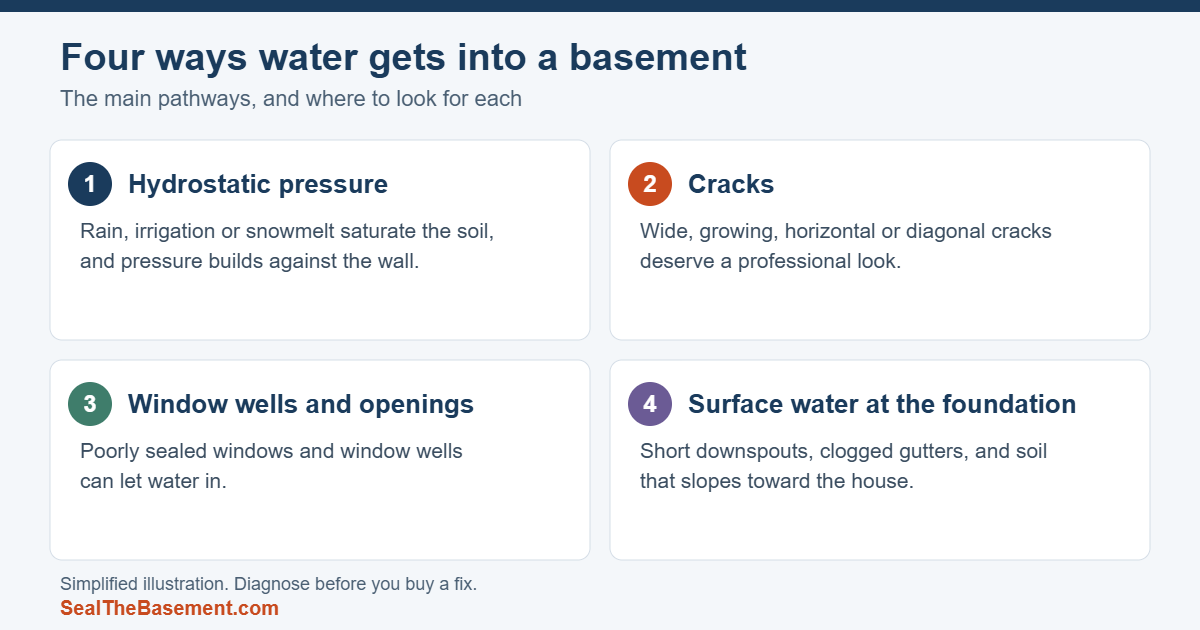
- Hydrostatic pressure. When rain, irrigation or snowmelt saturate the soil, pressure builds against the wall. ORNL says waterproofing is recommended where such pressure can occur. Seepage tends to appear along the wall-floor joint or across the wall face.
- Cracks. This Old House says wide, growing, horizontal or diagonal cracks deserve professional attention, and that hairline cracks are often cosmetic. Water that follows one crack often leaves staining or efflorescence along its path.
- Window wells and openings. The Building America Solution Center lists poorly sealed windows and window wells as a way water enters below-grade spaces.
- Surface water at the foundation. Short downspouts, clogged gutters and soil that slopes toward the house concentrate water at the wall. The EPA and Madison both cite these.
How to diagnose it
- Go down during the next rain. Mark where water appears with chalk or tape and note how long after the rain it starts.
- Check the weather pattern. Seepage that starts during rain suggests surface or soil-side water; seepage a day or two later suggests saturated soil and groundwater.
- Look outside. Check gutters, downspout outlets, soil slope and any window wells for standing water or debris. Our exterior drainage guide covers grading and gutter fixes.
- Test for condensation. Tape foil to the wall for 24 hours (This Old House). If the wall side is damp, water is coming through.
- Trace staining. Efflorescence and stains often line up with a crack or joint.
- Look for movement. Horizontal cracks, bowing, sticking doors or sloping floors need an engineer first (Bob Vila).
Which fix matches which cause
| Cause | Start here | If it persists |
|---|---|---|
| Roof water and surface runoff | Clean gutters, extend downspouts (5 to 10 feet per Pro Builder), regrade | Exterior drainage; see exterior drainage |
| Small stable crack seeping water | Hydraulic cement or caulk; see our crack guide | Injection by a pro |
| Seepage at the floor joint after storms | Fix surface water first | Interior drain and sump; see interior vs. exterior |
| Water around a window | Clear the well and its drain; keep soil below the sill | Check grading and well drainage |
| Horizontal crack or bowing | Structural engineer | Do not rely on patching |
| Damp walls, no active leak | Measure humidity; see the humidity guide | Dehumidifier and ventilation |
Interior coatings and why they fail
This Old House says waterproof paint alone is usually a temporary fix unless the moisture is very mild, and that interior treatments typically last about 10 years depending on drainage and soil. If the paint blisters after rain, the pressure is still there. Our guide to waterproofing a basement wall from the inside shows what coatings can and cannot do.
When to get professional help
- Recurring or severe water problems, or a high water table (This Old House).
- Water coming through the wall in many places.
- Horizontal or growing cracks, bowing walls or other signs of movement.
- Mold over about 10 square feet (EPA).
Compare at least three itemized quotes, ask about warranties and verify licensing. See how to hire a contractor and the cost guide.
Dry the space and prevent mold
Dry wet materials within 24 to 48 hours, as the EPA advises, and keep humidity below 60 percent, ideally 30 to 50 percent. See our basement humidity guide.
Soil, timing and what it tells you
Soil matters. This Old House says exterior work is recommended in clay-soil regions, where hydrostatic pressure is a bigger issue, and for persistent flooding where owners plan to stay long-term. If water arrives hours after rain stops, saturated soil is the likely source. If it arrives during rain, look at surface runoff.
Keep a simple rain log
| Date and rain | Where water appeared | Time it started | What was different outside |
|---|---|---|---|
| Example: heavy rain, 1 inch | North wall base | 2 hours after rain began | Downspout on that corner discharging at the wall |
| Example: light all-day rain | Window well | Next morning | Well full of leaves |
After two or three storms, patterns emerge, and a pattern is what a contractor needs to quote the right fix rather than the one they sell.
What not to do
- Do not paint over the wall and call it fixed. Paint over active seepage tends to fail.
- Do not patch every crack before you know where the water is coming from.
- Do not buy a pump first if downspouts are dumping at the wall.
- Do not sign for a full system without itemized quotes. For reference, This Old House lists interior work at about $3,000 on average and exterior work at about $7,000 for a 1,000 sq ft basement, and sump pump installation at $1,200 to $2,500; see our cost guide.
Related guides
How we put this guide together
This guide was drafted with AI assistance and then edited for the site against the public sources listed below. We are not engineers or contractors. Pathways and fixes combine sources from ORNL, Madison, the EPA, This Old House, Bob Vila and the Building America Solution Center. If you spot an error, use the contact page and we will correct it.
Sources
- Oak Ridge National Laboratory, Foundation Handbook: Drainage
- City of Madison: Prevent Basement Flooding
- U.S. EPA: A Brief Guide to Mold, Moisture, and Your Home
- This Old House: Foundation Cracks (updated April 2026)
- This Old House: DIY Guide: How to Seal Basement Walls (updated June 2026)
- Bob Vila: How to Know When You Should Repair a Foundation Crack (updated September 2025)
- Building America Solution Center (U.S. DOE / PNNL): Water Management of Existing Crawlspace Floor
- Pro Builder: Proper Backfilling and Grading for a Dry Foundation (March 2017)
Leave a Reply